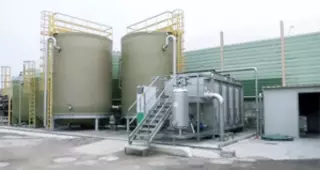
A safe, compact and digital RO desalination system. Its plug-and-play approach helps to secure a fast-track schedule while its embedded digital sensors provide remote monitoring.
Overview
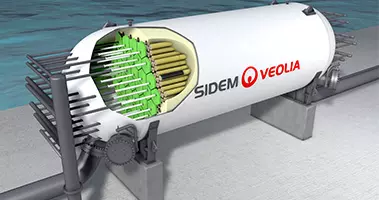
The Barrel was introduced to the market by SIDEM — a Veolia Water Technologies subsidiary — in 2019 as a major innovation for seawater desalination; however, it soon became obvious that the technology also perfectly addressed the challenges associated with water reuse.
How the Barrel works
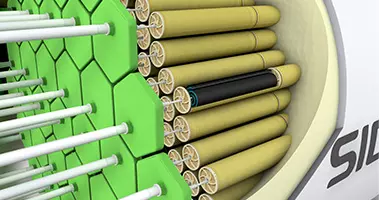
The Barrel enables the RO process implementation to be strictly identical to that of current RO pressure vessels. This ensures the fresh water produced meets all desalinated water quality standards for both municipal and industrial markets. It is also suitable for wastewater reuse and low pressure RO applications.
Barrel: A Smarter Way to Deliver Freshwater in a Changing Climate
As communities across Australia and New Zealand face increasing pressure on water resources, innovative and sustainable solutions are becoming essential. The Barrel offers a transformative approach to water treatment, combining compact design, energy efficiency, and cutting-edge membrane technology.
Its carbon steel pressure vessel is pre-fabricated and rigorously tested off-site, allowing for rapid delivery and simplified installation. This means projects can stay on track with minimal delays.
With a modular design, the Barrel is highly scalable, delivering from 400 up to 50,000 cubic metres of treated water per day per unit. It also offers an ideal retrofit option, replacing traditional RO desalination membranes and nanofiltration (NF) technology skids with a more cost-effective and forward-thinking solution.
Compact, Capable, and Outdoor-Ready
Perfectly suited for outdoor environments, the Barrel’s compact footprint reduces space requirements by up to 25%. It also removes the need for a climate-controlled environment, making it an ideal solution for the harsher conditions in Australia & New Zealand.
Its low energy consumption is equally impressive. This low-pressure reverse osmosis system reduces power usage by approximately 0.05 kilowatt-hours per cubic metre of fresh water produced, reinforcing its position as a more sustainable choice. Designed for both seawater and wastewater treatment, the Barrel uses low-pressure reverse osmosis to recover high-quality water at a lower cost.
Meeting the growing demand for clean water has never been more complex, but the Barrel empowers organisations to secure supply with a sustainable, economically viable solution.
Features and benefits
Simpler. Faster. Safer. Smarter.

Productivity
Delivers fresh water quality at significantly reduced operational costs through low-pressure RO.

Cost-Effective & Sustainable
A long-term water supply solution that aligns with both economic and environmental goals.

Smart Operation
Equipped with built-in digital tools for remote diagnostics and predictive maintenance.

Water Reuse Capabilities
Enables planned and regulated reuse of treated wastewater, creating a sustainable water loop.
Applications
Services

Contact
The Barrel is more than a means to take salt from seawater. It is a reverse osmosis or nanofiltration technology that has the power to solve many of our water resource issues, from securing residential drinking supplies to helping to ensure business resilience as the demand for water sharply rises. And after treatment, wastewater (municipal or industrial) becomes too valuable to dispose of and so we use the same technology to facilitate its reuse.

Elodie du Puytison
Product Manager — Barrel
Contact Elodie through her LinkedIn account
FAQ about the Barrel™
With predictions that by 2040, one in four children globally will live in areas of extreme water stress, RO desalination is already crucial. Countries such as Australia are experiencing the effects of climate change on water availability. Desalination provides a dependable way to augment supplies, especially in coastal or drought-prone regions.
By applying low-pressure reverse osmosis system technology to wastewater, it’s possible to recycle and reuse water multiple times. This reduces dependence on freshwater extraction and lowers environmental impact. Water reuse is now recognised as a key solution in achieving UN Sustainable Development Goal 6, with several countries (including Australia) introducing regulatory support for water recycling.
Nanofiltration (NF) technology uses membranes with slightly larger pores than traditional reverse osmosis, allowing it to remove smaller organic compounds, viruses, and divalent salts while retaining essential minerals. It is especially useful for treating surface water, groundwater, and even certain industrial process waters. In the context of the Barrel, it can be used as a flexible alternative or complement to RO desalination systems, offering enhanced performance with lower energy consumption.
Case studies
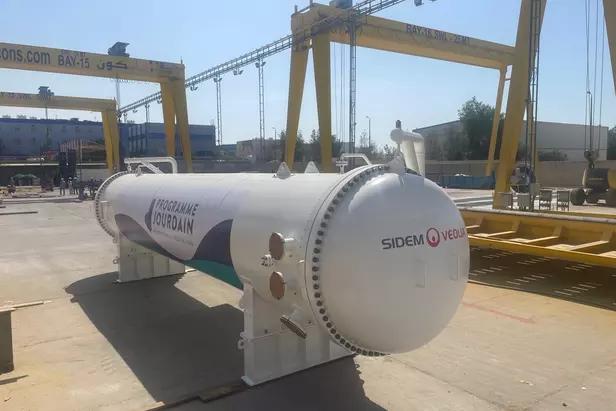
Reusing treated wastewater for indirect drinking water production— a first for Europe. The Barrel with a capacity of 3,600 cubic meters per day, has been delivered to the site. The full project is now under construction, testing will start in 2023 with full production scheduled for 2026.